
The first time I ever attempted to preach a sermon, I was a recent high school graduate studying engineering at the University of Arkansas. I was part of a small group of young adults who had been asked to preach ten-minute sermons during a New Year’s Eve gathering leading up to midnight.
I don’t remember my Scripture text. I don’t remember my topic. To be honest, I don’t remember much of anything I said. What I do remember is being absolutely terrified. My ten-minute sermon lasted probably around sixty seconds. I suppose I could say I was simply being respectful of everyone’s time, but the truth is I couldn’t wait to sit down.
I’ve preached quite a few sermons since that night and had the privilege of teaching preaching courses in Bible college. What began as something I could barely survive for sixty seconds became one of the greatest privileges and most significant responsibilities of my life.
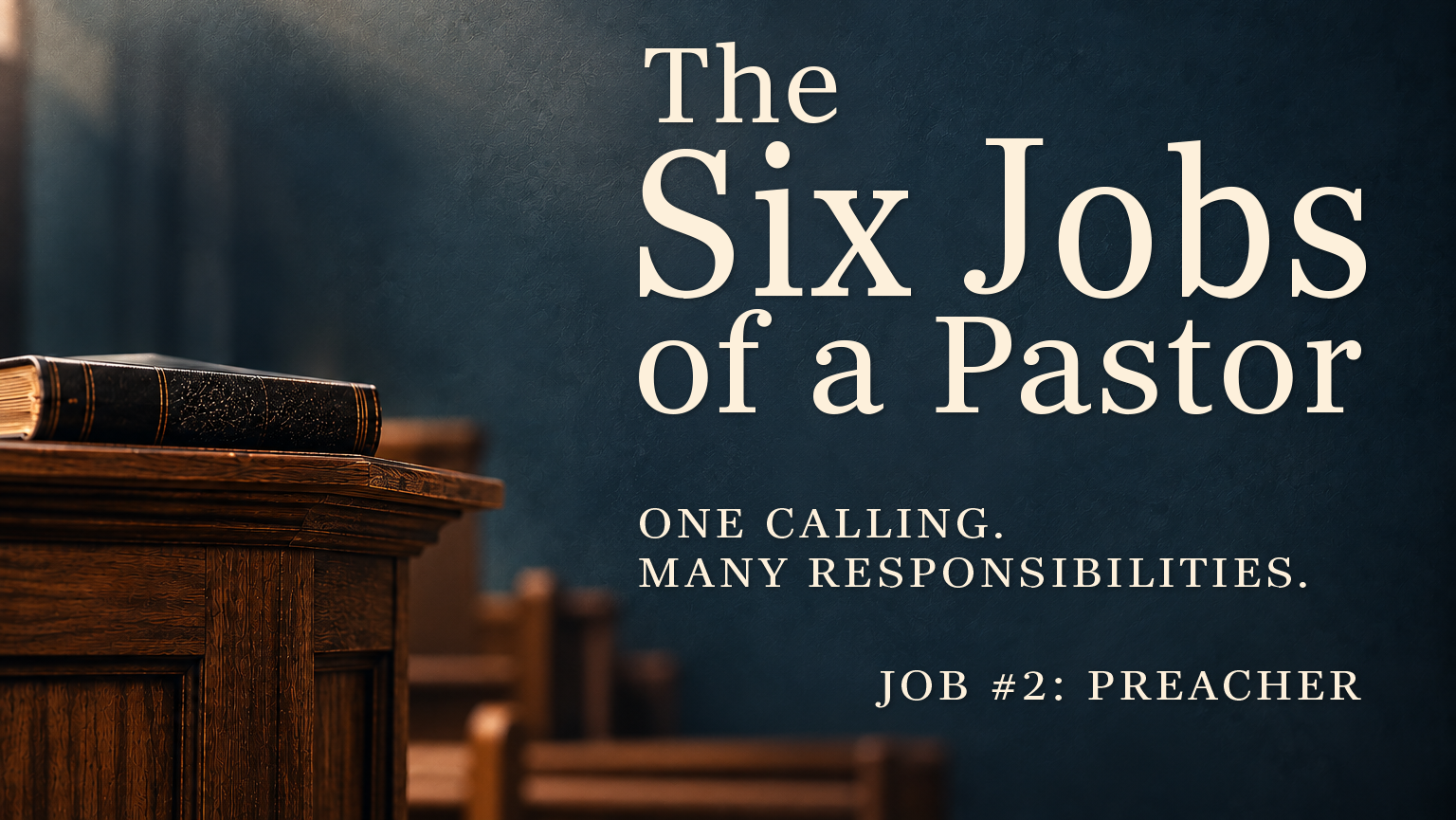
In this series, The Six Jobs of a Pastor, we’re considering six responsibilities of pastoral ministry. In the previous article, we looked at the pastor as shepherd, caring for the people God has entrusted to him. One important role of a shepherd is to feed the flock. For the pastor, that means faithfully preaching and teaching God’s Word.
A Responsibility Entrusted to the Pastor
When the apostle Paul wrote his final letter to Timothy, he gave him a straightforward charge:
“Preach the word! Be ready in season and out of season. Convince, rebuke, exhort, with all longsuffering and teaching” (2 Timothy 4:2).
Paul didn’t tell Timothy to become a gifted public speaker, develop an impressive preaching style, or build a reputation as a communicator. He told him to simply preach the Word.
Pastoral responsibilities vary depending on the size, structure, and needs of the church. But faithfully proclaiming Scripture is not optional. It is central to the calling.
Something I learned a long time ago is that Scripture is always more important than anything the preacher has to say about it. That means our responsibility isn’t to make the Bible agree with our message. It’s to make sure our message agrees with the Bible. Whether preaching through a book of the Bible, addressing a particular subject, or preparing a message for a special occasion, the authority must come from Scripture rather than the person delivering it.
Over time, a pastor’s preaching helps shape an entire congregation’s understanding of God, the Gospel, suffering, family, what it means to live out their faith, and so much more. A church is shaped not only by what its pastor preaches, but also by what he consistently neglects to preach.
The Joy and Weight of Preaching
There are Sundays when preaching feels almost effortless. The passage has come alive during preparation, the message seems to flow naturally, and you can sense that people are engaged with what God is saying through His Word. Those are wonderful moments in ministry.
There are other Sundays when preaching is difficult. Perhaps the passage is challenging, the preparation has been unusually demanding, or the pastor is carrying personal burdens that nobody in the congregation knows about. Sometimes the message requires addressing a difficult subject that would be easier to avoid. Other times, the pastor has spent hours preparing, preached with all his heart, and walks away wondering whether he communicated anything effectively.
I’ve experienced both!
One of the realities of pastoral ministry is that Sunday keeps coming. Regardless of how demanding the previous week has been, the responsibility of opening God’s Word before the congregation remains. Paul told Timothy to be ready “in season and out of season.” Faithfulness cannot depend on whether preaching feels easy, whether the congregation responds enthusiastically, or whether the pastor feels particularly confident. Some of the most important sermons may be delivered on days when the preacher feels least impressive.
That is why I believe preaching should be one of the most humbling experiences of a pastor’s life. We are standing before people God loves, opening a Book God inspired, and attempting to communicate truth with eternal significance.
In the moments before I stand to preach, I pray a simple prayer: “Lord, help me to speak with boldness and humility. With grace and truth. Empty me of me and fill me with You.”
Taking the Responsibility Seriously
During Bible college, I took a class called Preaching Workshop. Yes, that really was the name of the class. Every assignment involved preparing and preaching a sermon in front of our professor and classmates. I made the mistake of becoming friends with the professor. The good part of that friendship was that he genuinely cared about me and wanted me to improve. The challenging part was that he wasn’t afraid to tell me when I needed to improve.
I remember one particular sermon. I had worked through my introduction and was probably four or five minutes into the message when I heard his voice from the back of the classroom.
“Randy, start over. That was terrible.”
I wanted to disappear. There I was, standing in front of my friends, trying to figure out how to start over after being told that what I’d just done was terrible. But I started over.
Several years later, I had my first opportunity to preach at a national pastors’ conference. During the sermon, I decided to share that experience from Bible college. As I told the story, I heard a familiar voice from the back of the room.
“Randy, start over. That was terrible.”
It was the same professor. Thankfully, I could laugh about it that time. I’ve thought about that experience many times over the years. I’m grateful for someone who cared enough to challenge me and push me to become a better communicator of God’s Word.
If God has entrusted us with communicating His Word, we owe it to Him and to the people listening to take that responsibility seriously. That means doing the work of preparation, studying Scripture carefully, seeking to understand what the biblical author intended to communicate, and continuing to develop our ability to explain it. There is a difference between enjoying the opportunity to speak and accepting the responsibility of preaching.
Making God’s Word Understandable
Another important part of the pastor’s responsibility is making Scripture understandable to the people listening. We can spend hours studying a passage and understanding its meaning. But understanding it ourselves and communicating it clearly are two different things. I’ve heard it said that we shouldn’t simply communicate to be understood. We should communicate so clearly that we won’t be misunderstood.
I sometimes think about preaching to three chairs. In one chair sits someone who doesn’t know Christ as Savior. In another is a new believer who is just beginning to understand what it means to follow Jesus. In the third is a mature believer who has walked with the Lord for many years.
The unbeliever needs to understand the Gospel. The new believer needs help developing a biblical foundation. The mature believer still needs encouragement, correction, and opportunities to grow. We can’t address every spiritual need equally in every sermon, but remembering those three chairs helps us think beyond ourselves and consider the people who will be listening.
The pastor’s responsibility isn’t to impress people with how much he knows. It’s to help them understand what God has said. That doesn’t mean avoiding difficult passages or complicated theological truths. It means doing the work necessary to communicate them clearly.
Preaching for More Than Information
One of the dangers in preaching is confusing the transfer of information with spiritual transformation. I believe pastors should study diligently. I value theological education and careful biblical exposition. We should want our congregations to grow in their knowledge of Scripture. But knowing more about the Bible isn’t necessarily the same as becoming more like Christ.
A person can learn the historical background of a passage, understand the meaning of a Greek word, and remember the three points of a sermon without allowing any of it to change the way he lives. The purpose of preaching isn’t simply to fill people’s minds with biblical information. We want God’s Word to shape their hearts and lives.
I’ve heard it said that too many sermons answer questions nobody is asking. We can become so focused on explaining a passage that we fail to connect it to people’s everyday lives. Of course, Scripture must also confront us with truths we weren’t asking about and may not particularly want to hear. Our responsibility isn’t to allow people’s interests to determine what we preach.
What does this passage teach us about God? What does it reveal about ourselves? How should it influence the way we think, the decisions we make, and the way we treat others? Sometimes the appropriate response is repentance. Sometimes it is forgiveness, renewed faith, or a step of obedience. Sometimes it is recognizing our need for salvation through Jesus Christ.
The pastor cannot produce spiritual transformation through a well-prepared sermon. That is the work of God. But we can faithfully proclaim His Word, explain it clearly, and call people to respond. And over time, as a congregation consistently hears and responds to Scripture, lives are changed.
Faithful to the Calling
When I think back to that first sixty-second sermon all those years ago, I have to smile. I didn’t understand then the responsibility of preaching God’s Word week after week. And after all these years, I’m still learning. But the responsibility has remained the same.
Preach the Word.
We preach because God has entrusted us with His Word and called us to communicate it to His people. The greatest privilege of preaching isn’t having people listen to what I have to say. It’s helping them understand what God has already said. That is the responsibility of the pastor as preacher, and it is a responsibility worthy of our very best.
Pastors are called not only to proclaim God’s Word, but also to provide direction as the church follows Christ together. We will discuss that next in this series: The Pastor as Leader.
Click here to read The Six Jobs of a Pastor, Part 1: One Calling. Many Responsibilities.
Click here to read The Six Jobs of a Pastor, Part 2: Shepherd
Click here to read The Six Jobs of a Pastor, Part 3: Preacher
Click here to read The Six Jobs of a Pastor, Part 4:
Click here to read The Six Jobs of a Pastor, Part 5:
Click here to read The Six Jobs of a Pastor, Part 6:
Click here to read The Six Jobs of a Pastor, Part 7:
Click here to read The Six Jobs of a Pastor, Part 8:


Be the first to comment