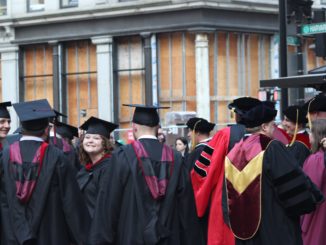
When we say at Boston Baptist College that “the world is our classroom,” we mean it.
For more than 25 years, Boston Baptist College students have traveled around the globe through the college’s annual study trips, combining classroom learning with firsthand experiences in places that have shaped biblical history and the transmission of Scripture. During the 2025–26 academic year, students visited Ireland, Egypt, and Greece. These countries provide invaluable context for the study of the Bible.
Last fall, our study trip took us to Ireland. I never stop getting questions about why we take study trips to Ireland. Quite simply, there is no place in the world more important to the transmission of the New Testament than Ireland.
Long before the influence of Rome reached the island, Irish scribes and scribal communities produced countless copies of Scripture while much of Europe drifted into the Dark Ages. If you love the Bible, there is nothing quite like walking through the ruins of an ancient Irish scribal community and imagining how God used faithful men doing careful, tedious work to preserve His Word for future generations.
In October, I experienced that once again while standing among the ruins of Enda’s sixth-century scriptorium on Inishmore. We are blessed today to have Scripture readily available, but understanding how God preserved His Word throughout history deepens our appreciation for that blessing.
Ireland also offers another remarkable opportunity for biblical study. Dublin is home to the Chester Beatty Papyri, among the most important New Testament manuscript collections in the world. These ancient documents are often described as the New Testament counterpart to the Dead Sea Scrolls.
One of my favorite moments as a professor is watching students with just enough Greek knowledge to work through a late second-century manuscript of a Gospel or Pauline letter. Their reaction is almost always the same. After a few moments of reading, they smile and say, “It’s the same.” Indeed, it is.
Last October, Dublin also hosted a special exhibition of ancient Irish manuscripts on Irish soil for the first time since they were written by Irish scribes more than 1,300 years ago. We were privileged to spend time with John Gillis of Trinity College Dublin, one of Ireland’s leading manuscript scholars, learning firsthand about the history and preservation of Scripture.
That would have been enough to make for an unforgettable year. Then came our spring study trip. A week in Egypt followed by a week in Greece gives both the mind and heart more to process than words can fully capture.
One of my favorite moments in Egypt came in the ancient city of Thebes, the region associated with both Joseph and Moses. We hired a guide with a traditional Egyptian sailboat, a felucca, and sailed on the Nile River while reading Exodus 2. The bulrushes along the riverbank were close enough to touch.
The monumental ruins of Egypt are breathtaking, but they also provide vivid commentary on Moses’ decision to identify with God’s people rather than enjoy the privileges of Pharaoh’s household. Standing among those remains reminds us that truth is always worth more than riches.
I also love taking students to Greece.
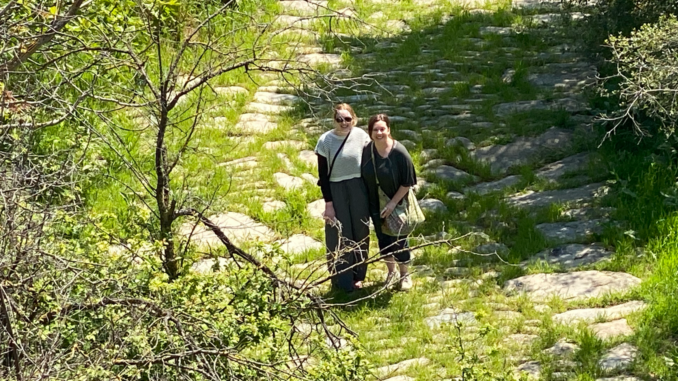
People often talk about following “the footsteps of Paul,” but in Greece we truly do. Walking portions of the ancient Roman roads helps us begin to understand what it must have been like for Paul to enter pagan cities armed with nothing more than the gospel of Jesus Christ and proclaim, “Christ in you, the hope of glory.”
And that does not even include walking the remote Isle of Patmos.
Some experiences are difficult to explain. Patmos is one of them. You simply have to experience it for yourself.At Boston Baptist College, studying the Bible is not merely an academic exercise. We read it, study it, and experience the places connected to its history and message. These study trips help students move beyond information to deeper understanding, equipping them not only to be educated, but to be eternally changed.
Note: The image is on the Via Egnatia leading into ancient Philippi.