
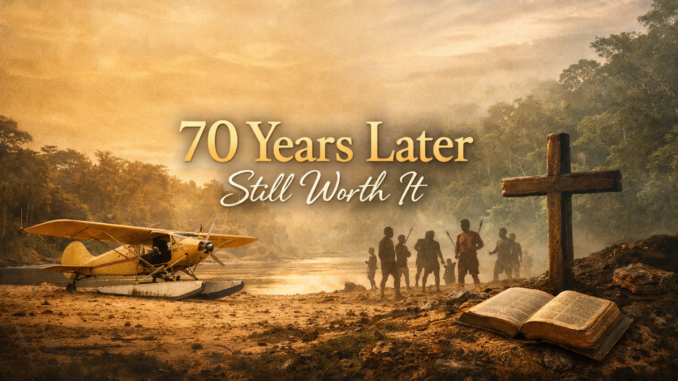
Today marks the 70th anniversary of one of the most sobering and stirring moments in modern missions history.
On January 8, 1956, five young missionaries, Jim Elliot, Pete Fleming, Ed McCully, Nate Saint, and Roger Youderian, were killed while attempting to make contact with the Waodani people in Ecuador. They had spent months flying over remote jungle territory, lowering gifts in a bucket, trying to communicate peace and friendship to a tribe known for violent encounters with outsiders. Believing that a level of trust had been established, they landed on a small sandbar to meet the tribe face to face.
They never returned.
For many, the immediate question then, and even now, is painfully simple. Was it worth it?
I first learned this story in Bible college, studying it as part of missions history. Years later, as a young dad and a young pastor in Michigan, I watched the movie End of the Spear, and it suddenly felt far more real, with faces, families, and irreversible decisions. I also attended a Steven Curtis Chapman concert where I heard Steve Saint tell the story as a son who lost his father.
In moments like that, the story comes back into focus, not as a legend, but as real men who paid a real price.
Five promising lives, five families changed forever, five ministry futures cut short in an instant. From a purely human standpoint, the story feels tragic and unfinished. It feels like a plan that failed.
But heaven has never measured success the same way we often do.
Within two years of their deaths, Elisabeth Elliot and Nate Saint’s sister, Rachel, made peaceful contact with the Waodani. They lived among them. Relationships were built. The gospel was shared. The Scriptures were translated into their language. And in one of the most powerful testimonies of grace the world has ever seen, several of the very men who killed the missionaries became followers of Jesus Christ.
What looked like defeat became the doorway to redemption. What seemed like a loss became the seed of transformation.
Jesus said in John 12:24, “Most assuredly, I say to you, unless a grain of wheat falls into the ground and dies, it remains alone; but if it dies, it produces much grain.” Those five men never saw the harvest with their own eyes, but their obedience planted a gospel legacy that still speaks today.
Seventy years later, their story still confronts us with uncomfortable questions. Not, “Would I die for Christ?” But, “How am I living for Him?”
Seventy years later, their story still confronts us with uncomfortable questions. Not, “Would I die for Christ?” But, “How am I living for Him?” Click To TweetMost of us will never face a moment as they did on that riverbank, but we do face daily decisions about obedience. Faithfulness is rarely dramatic, but it always comes with a cost. It shows up in how we serve, how we give, how we forgive, and how we choose Christ over everything else in the ordinary routines of life.
Jim Elliot once wrote, “He is no fool who gives what he cannot keep to gain what he cannot lose.” Those were not just poetic words in a journal. They were convictions that shaped his life and ultimately his death.
And they challenge our convictions.
What are we holding onto that is keeping us from stepping fully into what God has called us to do? What conversations are we avoiding? What acts of obedience are we postponing?
We often pray for revival, for growth, for impact in our churches and communities. But history, and Scripture, remind us that God’s greatest movements are often built on unseen faithfulness and sometimes on costly obedience that never makes headlines.
The five missionaries who died on that sandbar were not famous men chasing a dream. They were ordinary servants who believed that the Waodani people mattered to God and that the gospel was worth everything.
Their story also reminds us that no sacrifice for Christ is ever wasted. God wastes nothing. Not tears. Not loss. Not prayers. Not obedience that seems unanswered. What we may never see on this side of heaven, God is still using in ways far beyond our imagination.
Some of the most powerful ministry moments we will ever have will not come with applause. They will come quietly, faithfully, sometimes painfully, and often without immediate results. But eternity keeps better records than we do.
For pastors, missionaries, and ministry leaders, this 70-year anniversary is a reminder that we are not called to build comfortable careers. We are called to be faithful to the gospel. We are not called to avoid risk. We are called to trust God.
For churches, it is a reminder that missions is not an optional program on the calendar. It is central to the heart of God. The Great Commission was not a suggestion. It is a command. The gospel is meant to go to every people group, every neighborhood, every nation, and every generation.
And for every believer, it is a reminder that our lives are not our own. We have been bought with a price. The question is not whether following Jesus will cost us something. The question is whether we believe He is worth everything.
The question is not whether following Jesus will cost us something. The question is whether we believe He is worth everything. Click To TweetSeventy years later, the blood that was shed on that riverbank still speaks. Not of tragedy alone, but of triumph. Not of loss alone, but of legacy. Not of death alone, but of life that multiplied far beyond what anyone could have imagined.
The Word of God was translated. The Waodani people heard the gospel. Souls were saved. Churches were planted. And generations were changed because five men were willing to obey, even when obedience was dangerous.
So today, we remember them. We honor their sacrifice. But more than that, we allow their story to ask us a simple, searching question.
What is my obedience costing me?
And am I willing to pay that price for the sake of the One who paid everything for me?
Seventy years later, the answer from that Ecuadorian sandbar is still the same.
Yes, it was worth it.


God never fails us, we fail him. The measure of sacrifice is what is left behind.
Delores Swearingin
Missionary to Mexico. 43 years
Life of missionary Don , Swearingin